Cash-Secured Put Tracker
Premium, Collateral and Assignment for Every CSP
OptionsVault keeps each cash-secured put you sell as its own position: what you collected, what you paid to close it, and what happened at expiration.
What Is a CSP in Options?
CSP stands for cash-secured put. You sell a put option on a stock you would be happy to own, and you keep enough cash in your account to buy 100 shares at the strike price. In return you are paid a premium up front.
Say AMD trades at $155 and you sell the $150 put expiring in 30 days for $3.20 per share. You collect $320 and set aside $15,000. If AMD is above $150 at expiration, the put expires worthless and the $320 is yours. If it is below, you buy 100 shares at $150, which after the premium is an effective $146.80 per share.
Either way you keep the premium. What you give up is the chance to wait for a lower price, and you take on the risk that the shares fall well below your strike.
How to Calculate a Cash-Secured Put
Five numbers describe any cash-secured put. These use the same AMD $150 put:
| Number | How to work it out | Example |
|---|---|---|
| Collateral | Strike × 100 shares, for each contract | $150 × 100 = $15,000 |
| Premium collected | Premium per share × 100, minus anything paid to buy the put back | $3.20 × 100 = $320 |
| Break-even | Strike − premium per share | $150 − $3.20 = $146.80 |
| Return on collateral | Premium ÷ collateral | $320 ÷ $15,000 = 2.1% in 30 days |
| Most you can lose | (Strike − premium) × 100, if the shares went to zero | $146.80 × 100 = $14,680 |
Repeated every 30 days, a 2.1% return works out to about 26.0% a year. Real results vary, because premiums change and some puts get assigned. To run these numbers for a put of your own, use the free cash-secured put calculator.
Cash-Secured Put Payoff Chart
A put you sold earns the premium and no more, however far the stock rises. Below the strike it loses a dollar for every dollar the stock falls, starting from a better place than the shares would. Here it is next to buying 100 AMD shares outright on the same day:
Cash-Secured Put Example: Two Puts on AMD
Most put sellers repeat the trade. Here the first put expires and the second, at a lower strike, is assigned:
| Action | Premium | Collateral | Break-even |
|---|---|---|---|
| Sell AMD $150 put (30 days out) | +$320 | $15,000 | $146.80 |
| AMD stays above $150: put expires worthless | Kept | Released | — |
| Sell AMD $145 put (30 days out) | +$280 | $14,500 | $142.20 |
| AMD falls to $143: assigned 100 shares at $145 | Kept | Buys 100 shares | — |
| Total | $600 premium | 100 shares at $142.20 effective | |
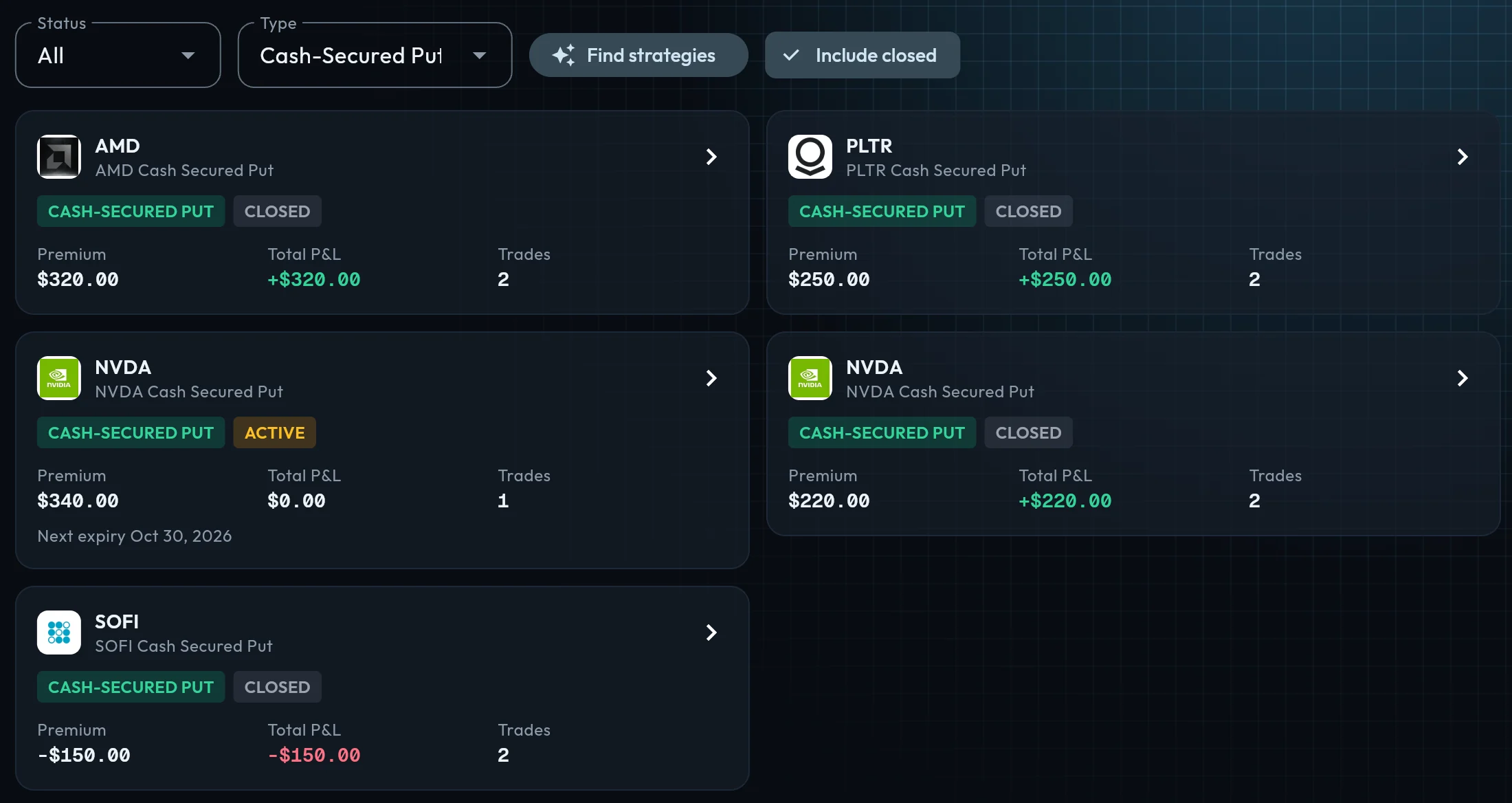
You end up owning 100 shares bought at $145. After the premium from the put that was assigned, they cost an effective $142.20 each. Count the $320 from the first put as well and the figure is $139.00. In OptionsVault the first put is a closed position with $320 of premium and +$320 realized. The second put and the shares it bought can be grouped as the start of a wheel.
Fees are left out. Prices are made up for the walkthrough, not quotes. The effective price is a trading number, not your tax basis: for taxes, use the records your broker sends you.
What OptionsVault Tracks for Cash-Secured Puts
Three ways to get trades in
Connect your broker for automatic sync (Pro), import a CSV export, or type trades in by hand.
Finds your cash-secured puts
OptionsVault spots each put you sold to open, pairs it with its buy-back if there was one, and suggests it as a cash-secured put position.
Premium and P&L per position
Each position shows premium collected (net of buy-backs), realized P&L, and how many trades are still open.
Expirations and assignments handled
A put that expires or is assigned is closed with its full premium realized. Each open position shows its next expiration date.
Assignment leads into the wheel
When a put is assigned and the shares arrive, OptionsVault suggests grouping them as the start of a wheel (Pro), with the next step: sell a covered call.
See how your puts are doing overall
Analytics compares cash-secured puts with your other strategies: P&L, win rate and premium. P&L is also broken down by ticker, by month and on a calendar.
OptionsVault is a tracker, not a screener: it does not scan for puts to sell, show live Greeks, track your buying power or send assignment alerts.
What Happens to a CSP at Expiration
Stock ends above the strike
Put expires worthless
You keep the whole premium, your cash is free again, and you can sell another put.
Stock ends a little below the strike
Assigned 100 shares
You buy the shares at the strike. Above your break-even you are still ahead once the premium is counted.
Stock falls a long way
Assigned at a loss
You buy the shares at the strike while they trade for less. The premium softens the loss but does not remove it.
Choosing a CSP Strike Price by Delta
The strike decides both the premium and how likely you are to be assigned. Many put sellers use delta as a guide: it is a rough estimate of the chance the option finishes in the money.
Around 0.15 to 0.20 delta: well below the current price. Less premium, and roughly a four-in-five chance the put expires worthless.
Around 0.25 to 0.30 delta: the middle ground many income sellers use.
Around 0.35 to 0.45 delta: close to the current price. More premium and a real chance of assignment. Use it when you want to own the shares at that price.
Delta and the other terms are explained in our guides to choosing a strike price (written for option buyers, though delta reads the same way) and options terminology.
Cash-Secured Puts and the Wheel Strategy
A cash-secured put is the first step of the wheel strategy. When the put is assigned you own the shares, and you sell covered calls against them until they are called away. On the Pro plan, OptionsVault groups the put, the assigned shares and the calls as one wheel, so you see the return on the whole cycle.
Cash-Secured Put Questions
What does CSP mean in options?
CSP stands for cash-secured put. You sell a put option and keep enough cash in your account to buy 100 shares at the strike price if the option is assigned. You are paid a premium for taking on that obligation.
How much cash do I need for a cash-secured put?
The strike price times 100 shares, for each contract. One put with a $150 strike needs $15,000 set aside. The premium you receive lowers what you would effectively pay, but brokers generally require the full strike amount as collateral.
How do you calculate the return on a cash-secured put?
Divide the premium by the collateral. A $320 premium on $15,000 of collateral is 2.1%. To compare puts of different lengths, multiply by 365 and divide by the days to expiration: over 30 days that is about 26.0% a year.
What happens when a cash-secured put is assigned?
You buy 100 shares at the strike price and keep the premium, so your effective price is the strike minus the premium. In OptionsVault the put is closed with its premium realized, and the put and the shares can be grouped as the start of a wheel.
Does OptionsVault screen for puts to sell or send alerts?
No. OptionsVault is a tracker and journal. It does not scan the market for puts, suggest strikes, show live Greeks or send assignment alerts. It records the puts you have sold and shows what they earned.
Is the cash-secured put tracker free?
Cash-secured put tracking is part of the free plan, using manual entry or CSV import, with a limit on how many positions can be active at once. Connecting a broker for automatic sync needs Pro. The pricing page has the current limits and price.
See pricing for what the free and Pro plans include.
Start Tracking Your Options Trades Today
Join options sellers who use OptionsVault to track strategies, analyze performance, and grow their portfolio. Free to start.